

Over the past several Executive Briefs, we've explored a series of changes affecting modern businesses. At first glance, they appear unrelated. Search has changed. Customers have changed. Websites have changed. Technology has changed. Together, however, they point toward a much larger conclusion. Customer acquisition itself has fundamentally changed, and businesses that continue using yesterday's strategy will increasingly struggle to compete.
Every generation of business leaders faces a moment when long-established assumptions no longer hold true.
This is one of those moments.
For years, customer acquisition followed a relatively predictable pattern.
That strategy reflected how customers behaved.
Today's environment is different.
None of these changes occurred in isolation.
Together, they have reshaped the entire customer journey.
That means businesses must rethink the way they attract, educate, and engage prospective customers.
Customer acquisition is no longer about generating attention alone.
It is about creating confidence at every stage of the journey.
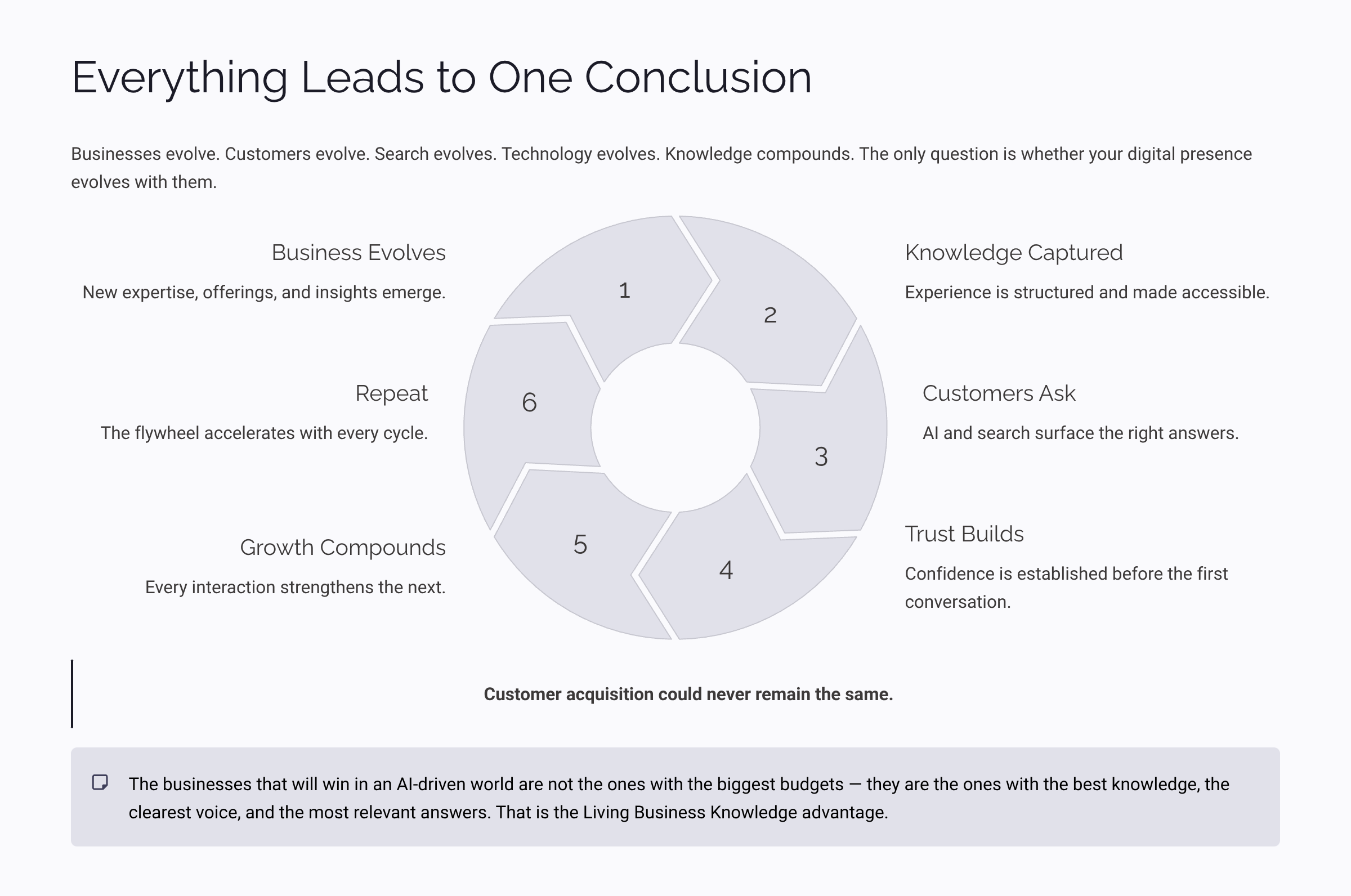
Many organisations continue investing in individual marketing tactics.
Each initiative has merit.
But none of them, on their own, addresses the underlying shift.
The real opportunity lies in bringing every customer interaction together into one coherent experience.
When each stage builds naturally on the previous one, customer acquisition becomes more than a collection of marketing activities.
It becomes a business strategy.
Businesses changed. Customers changed. Customer acquisition had to change too.
If your current customer acquisition strategy were designed from scratch today—not ten years ago—what would you build differently?
This Executive Brief is part of our series: From Static Websites to Living Business Knowledge
Previous Brief
Every Generation of Technology Reduces Friction
Next Brief
Read the Complete Position Paper
From Static Websites to Living Business Knowledge
Next Executive Brief
If customer acquisition has fundamentally changed, how can smaller MSPs compete in markets dominated by larger, better-known providers?
Next, we'll explore why waiting to be discovered is no longer enough—and how Bottom-Up Discovery creates opportunities that traditional search alone cannot.
Executive Briefs are concise thought-leadership articles exploring how customer acquisition is changing in the age of AI search, conversational experiences, and Living Business Knowledge. Each brief examines one idea in depth and forms part of the larger position paper, From Static Websites to Living Business Knowledge.