
Every business changes.
Not once every five years.
Not when a new website is commissioned.
Every day.
Successful businesses never stand still.
They learn.
They adapt.
They grow.
Yet remarkably, most businesses still treat their digital presence as though it were a completed project.
A website is commissioned.
Content is written.
Pages are approved.
The site goes live.
Then... almost nothing changes.
Months pass.
Sometimes years.
Eventually, the website is redesigned, largely because it looks outdated or no longer reflects the business accurately.
The process begins again.
For more than two decades, this model has been accepted as normal.
But what if the problem isn't the website?
What if the problem is the way we've been thinking about websites?
Perhaps we've been asking the wrong question.
Instead of asking:
"How do we build a better website?"
Perhaps we should be asking:
"How should a modern business represent itself digitally?"
Those are fundamentally different questions.
That distinction has never mattered more than it does today.
Artificial intelligence, conversational search, and changing customer expectations are transforming the way businesses are discovered, evaluated, and ultimately chosen.
Increasingly, customers expect immediate, relevant answers rather than lists of links.
Throughout this paper, we explore a simple proposition.
Not that websites are disappearing.
Not that artificial intelligence replaces good marketing.
And certainly not that technology alone creates growth.
Rather...
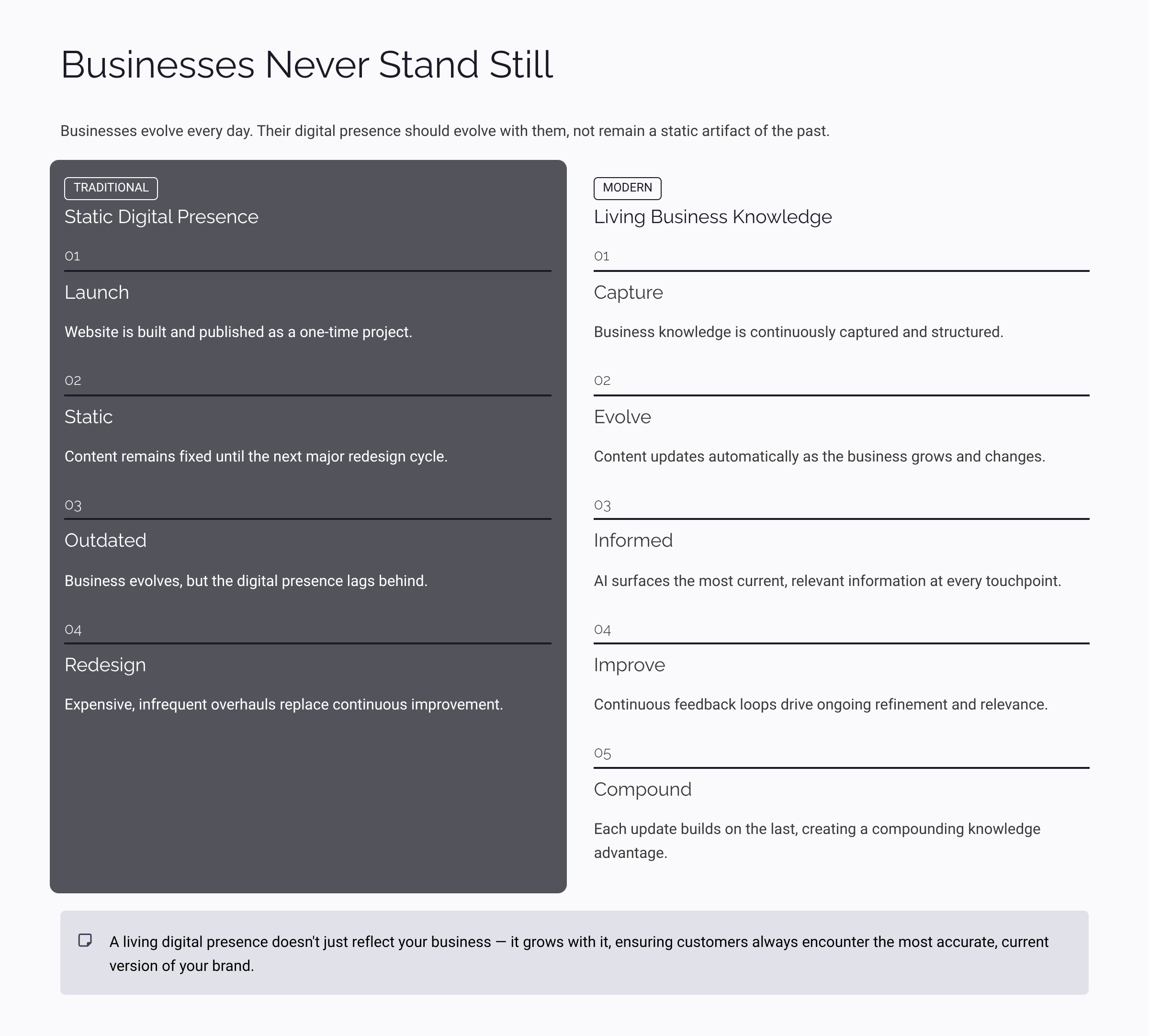
Businesses are living organizations.
Their digital presence should be living too.
Key Insight
Businesses don't outgrow their websites.
They outgrow static representations of their knowledge.
The future belongs to businesses whose digital presence evolves as quickly as they do.
For decades, businesses designed their websites around a simple assumption.
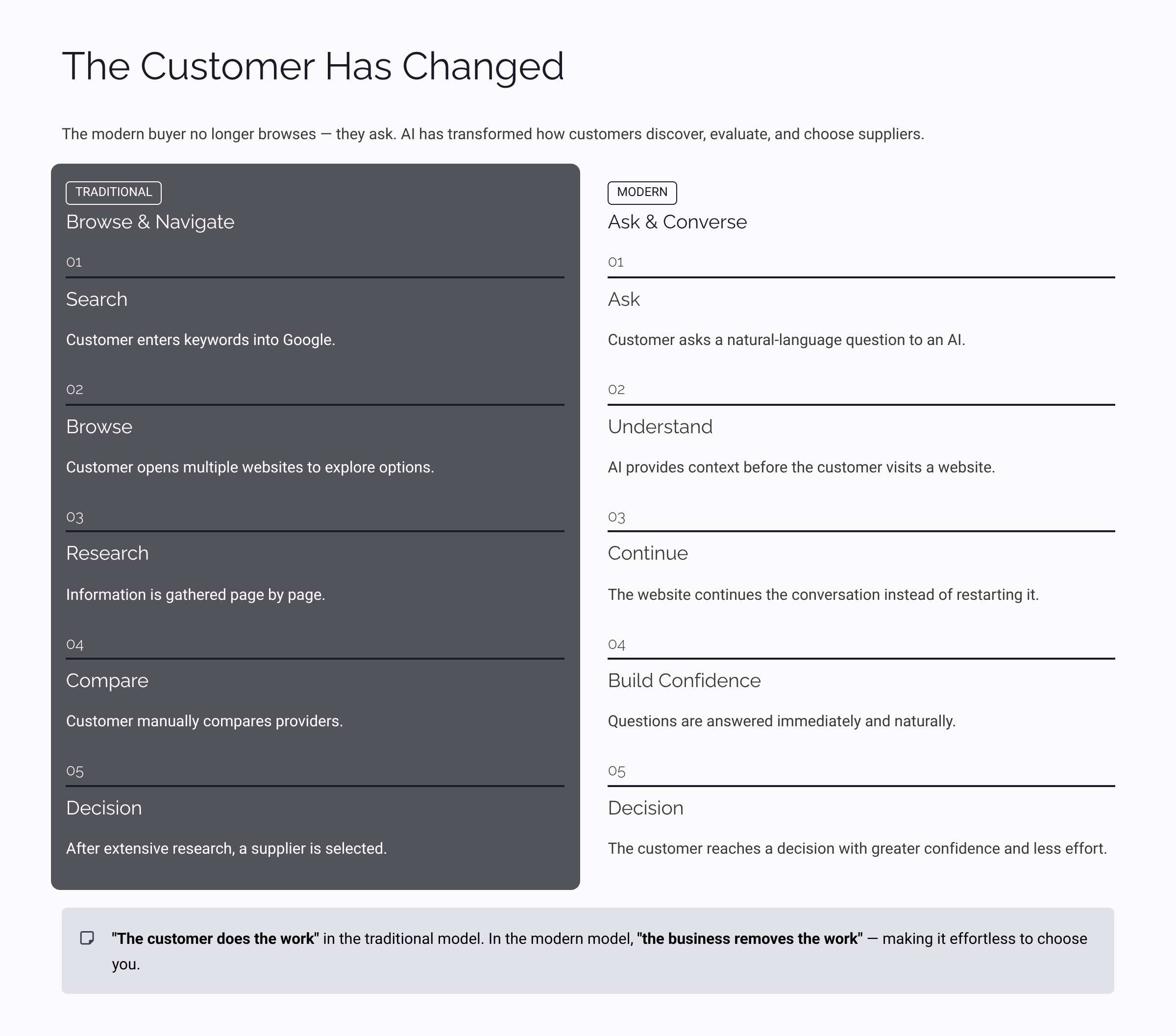
Customers would search.
Eventually, they would find the information they needed.
That assumption shaped almost every business website built during the past twenty-five years.
Entire industries emerged around helping visitors click through websites more efficiently.
It worked because customers had few alternatives.
If they wanted information, they had to go looking for it.
Today, that assumption is quietly disappearing.
Think about your own behaviour.
The last time you needed an answer, did you instinctively open half a dozen websites and compare their navigation?
Or did you simply ask a question?
Whether we're planning a holiday...
Researching a software platform...
Troubleshooting a printer...
Or looking for a local service provider...
Increasingly, we expect immediate, conversational answers rather than a list of links.
That change didn't begin with artificial intelligence.
Artificial intelligence simply accelerated a shift that was already underway.
Every generation of technology has reduced friction.
Customers didn't adopt these technologies because they were more impressive.
They adopted them because they were easier.
Conversational search represents the next step in exactly the same evolution.
People are discovering that asking a question is easier than searching through websites.
Once that expectation develops, it becomes remarkably difficult to reverse.
This has profound implications for every business.
For years, organizations have focused on making websites easier to navigate.
The challenge now is fundamentally different.
Should visitors need to navigate at all?
That single question challenges almost everything we've assumed about digital marketing.
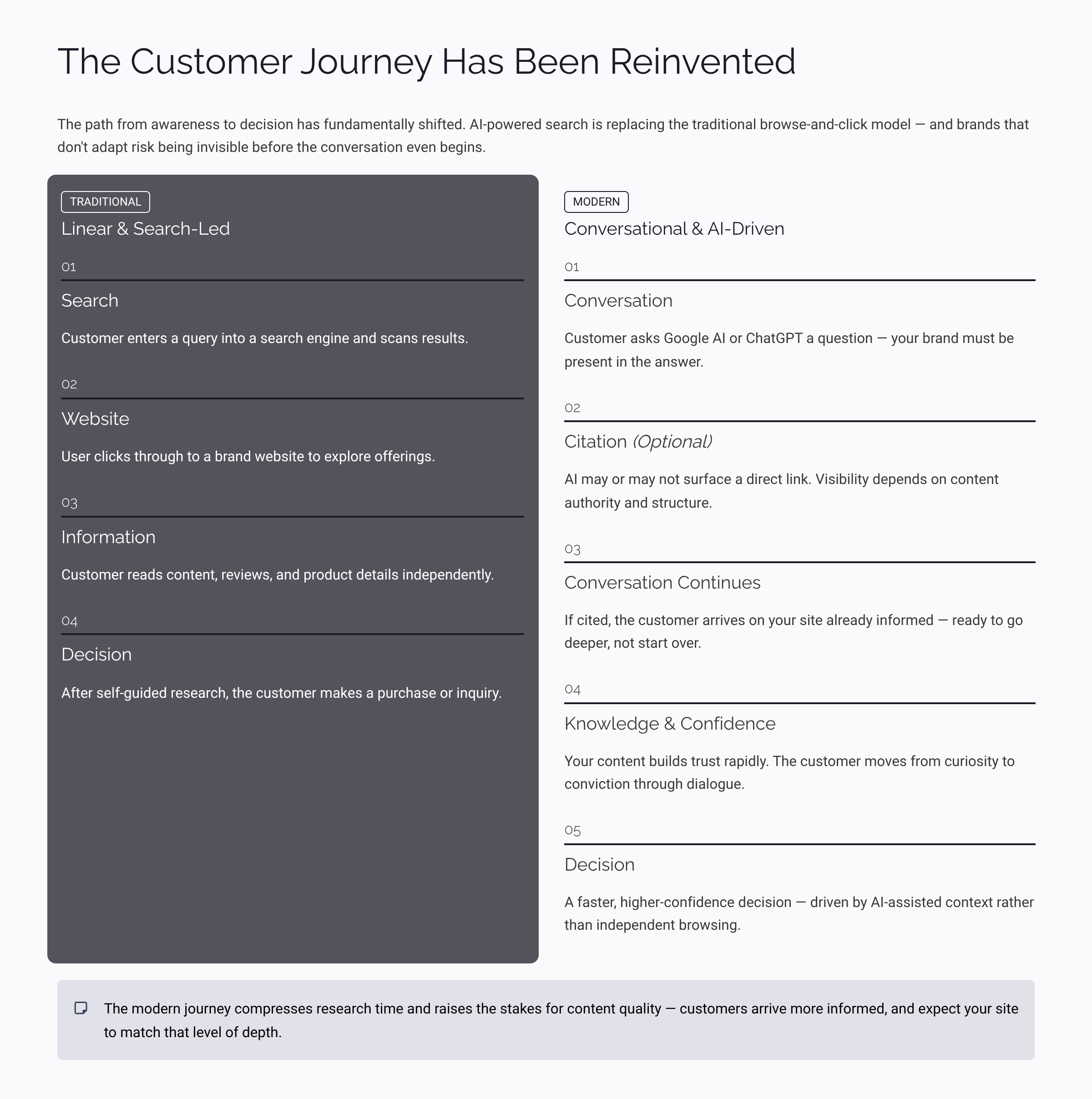
If customers increasingly begin their journey through conversation rather than navigation, then businesses must begin thinking differently about the experiences they provide after discovery.
The objective is no longer simply to publish information.
The objective is to make knowledge immediately accessible, understandable, and useful.
The businesses that thrive over the next decade won't necessarily be those with the biggest websites.
They'll be the ones that make it easiest for customers to continue the conversation.
Technology changed.
Customer expectations changed with it.
The businesses that recognize that shift early will be the ones best positioned to build lasting competitive advantage.
Key Insight
Customers no longer compare websites.
They compare experiences.
The businesses that reduce customer effort will consistently outperform those that expect customers to do the work themselves.
For more than twenty years, the relationship between search engines and business websites was remarkably straightforward.
The more visible your website became, the more opportunities you created to engage prospective customers.
That model shaped an entire industry.
Search Engine Optimization (SEO) became one of the most important disciplines in digital marketing.
Businesses invested heavily in content, backlinks, technical optimization, and authority because higher rankings generally translated into more visitors.
For many years, that relationship worked remarkably well.
Today, something has changed.
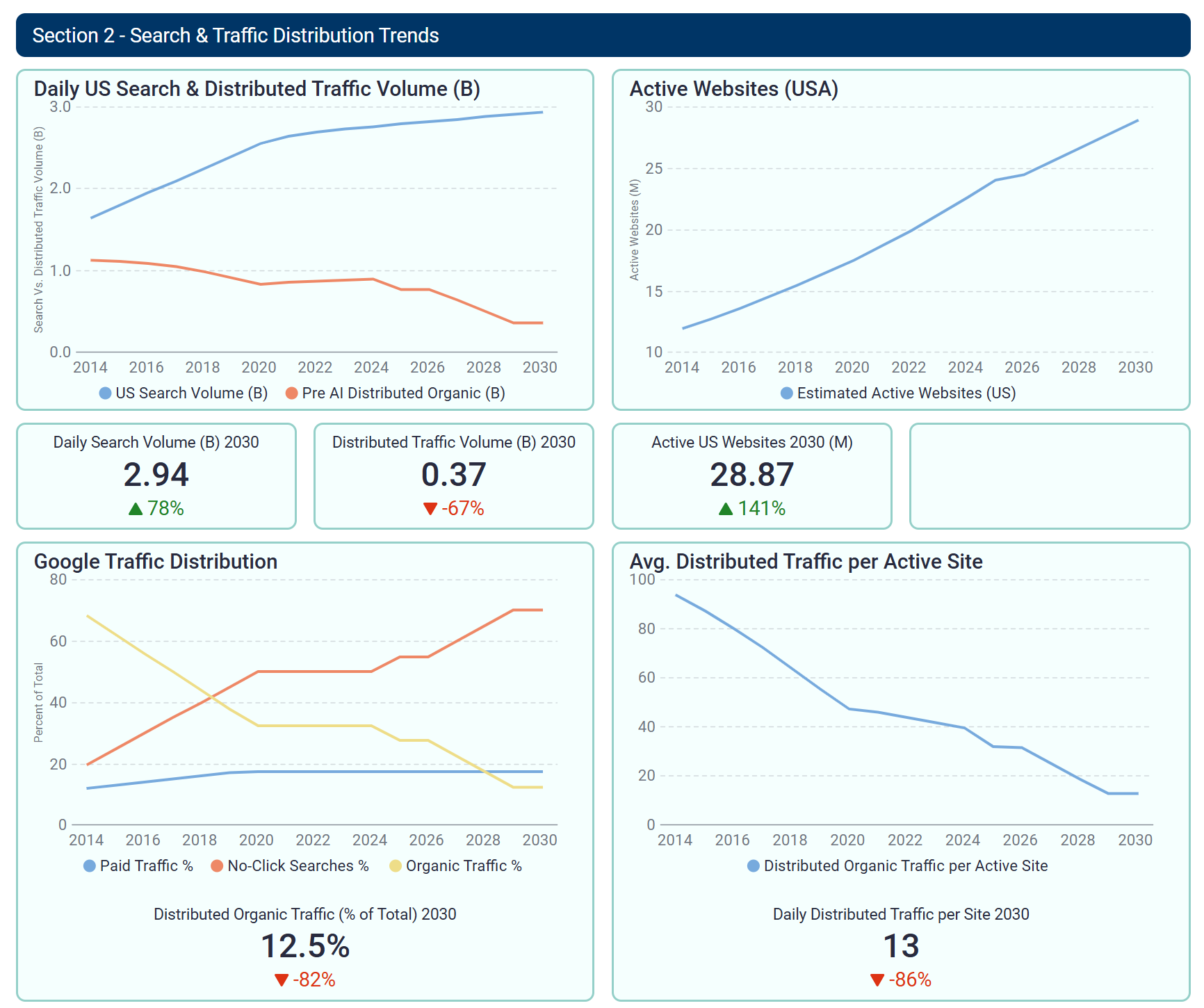
People continue to search.
In fact, global search activity continues to increase.
Yet the amount of traffic reaching business websites is steadily declining.
At first glance, this appears contradictory.
How can more people be searching while fewer people are visiting websites?
The answer lies in the way search itself has evolved.
This is often described as the rise of zero-click search.
The name is less important than the implication.
Businesses can no longer assume that increased search activity will automatically translate into increased website traffic.
The relationship between search and websites has fundamentally changed.
For larger organizations with strong digital authority, this shift presents new challenges.
For smaller businesses, the implications are even more significant.
Many local businesses already struggle to appear prominently in competitive search results.
If fewer visitors are clicking through to websites in the first place, relying exclusively on traditional SEO becomes an increasingly uncertain growth strategy.
This doesn't mean search is becoming less important.
Quite the opposite.
Search remains one of the primary ways customers discover businesses.
But discovery is no longer the destination.
It is simply the beginning of a much longer customer journey.
The businesses that succeed will not be those that chase rankings alone.
They will be the businesses that understand what happens after discovery.
Because being found has never guaranteed being chosen.
And increasingly... being found may not even guarantee a website visit.
That reality changes how businesses should think about digital growth.
Key Insight
Search still creates opportunity.
It no longer guarantees attention.
The businesses that thrive will be those that optimize not only for discovery - but for everything that follows.
For years, digital marketing has focused on a single objective.
Get found.
Today, that objective is expanding.
As AI-powered search becomes more prevalent, businesses are increasingly asking a different question:
"How do I earn a citation?"
It's a sensible question.
If Google AI, ChatGPT, or another conversational platform recommends your business, you've earned something valuable.
You've earned attention.
But attention should never be confused with acquisition.
A citation simply creates an opportunity.
The customer journey has not ended.
In many ways, it has only just begun.
This distinction is becoming increasingly important.
Much of today's discussion around AI search focuses on the mechanics of becoming visible.
Far less attention is given to what happens after visibility has been achieved.
Imagine two MSPs.
Both are cited by an AI assistant.
One directs the visitor to a traditional website where information is spread across service pages, navigation menus, blog articles, and downloadable PDFs.
The other immediately continues the conversation.
Questions are answered naturally.
Expertise becomes evident.
Confidence builds quickly.
Both businesses earned exactly the same opportunity.
Only one converted it into a customer.
The competitive advantage wasn't the citation.
It was everything that happened afterwards.
This represents a subtle but profound shift in thinking.
For years, businesses optimized primarily for discovery.
Tomorrow's leaders will optimize for continuity.
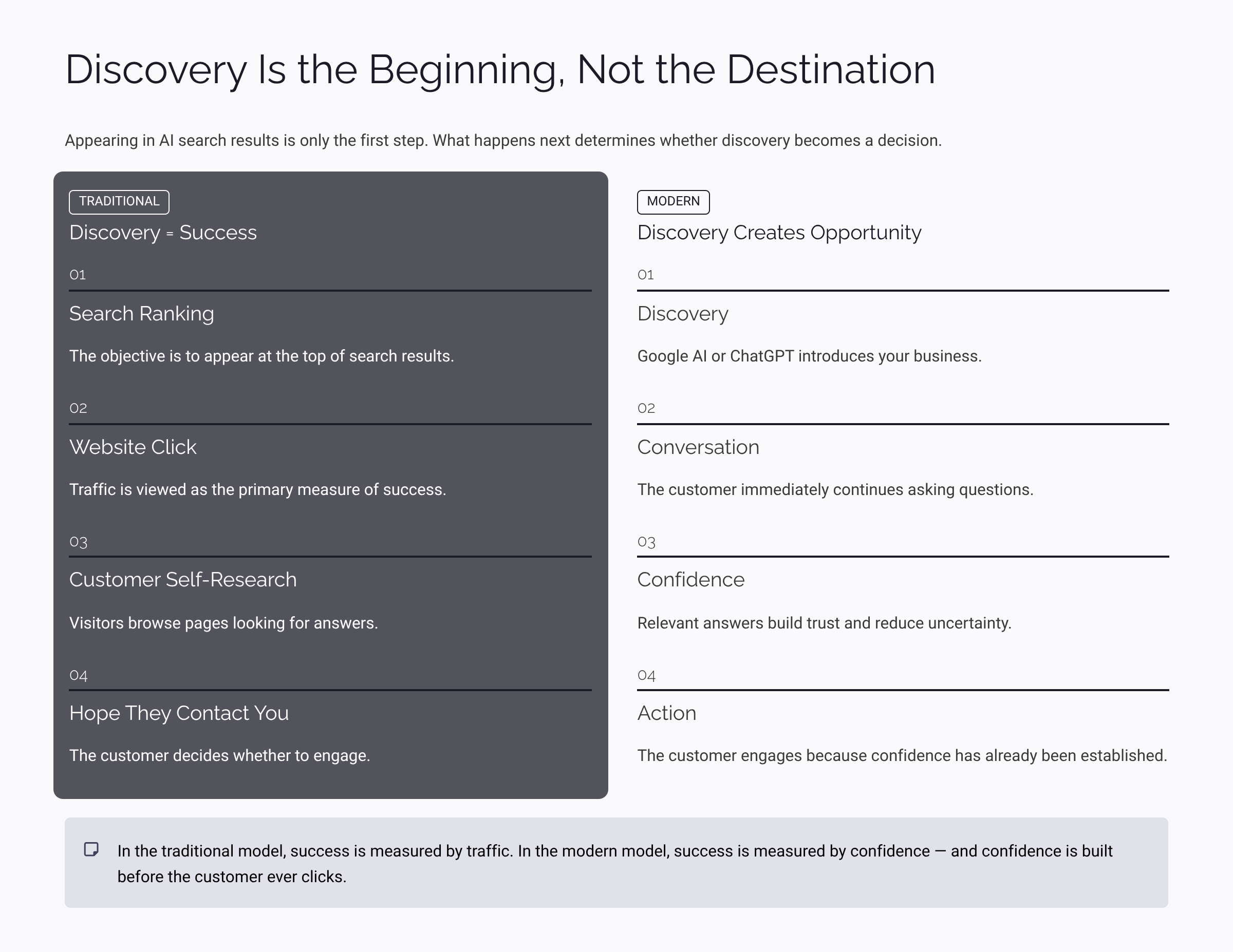
The transition from discovery...
to conversation...
to confidence...
is becoming one continuous experience.
Businesses that understand this distinction will begin measuring success differently.
Not simply by traffic.
Not even by citations.
But by the quality of the customer journey that follows.
Discovery creates opportunity.
Conversation creates confidence.
Confidence creates customers.
That sequence will become increasingly important as search continues to evolve.
Key Insight
Visibility starts the customer journey.
It does not complete it.
Businesses that convert attention into confidence will consistently outperform businesses that focus on attention alone.
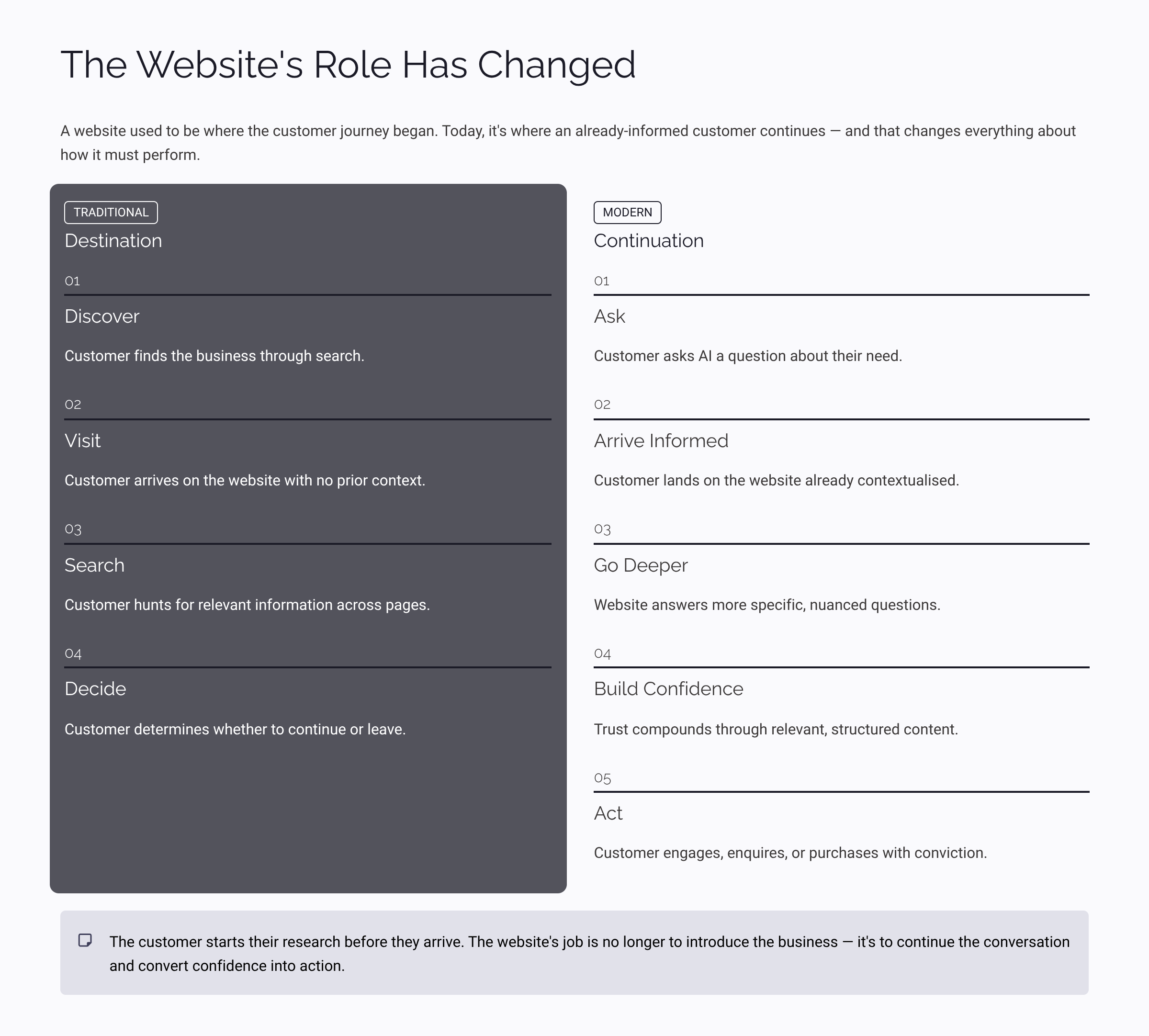
For more than two decades, business websites served one primary purpose.
They were destinations.
A customer discovered a business through search, advertising, or a referral, arrived at the website, and began the process of learning.
The website represented the beginning of the digital relationship.
Everything that followed depended upon the visitor's willingness to browse.
That model reflected the technology of its time.
It made sense when search engines simply returned lists of websites and customers expected to perform their own research.
Today's customer journey is fundamentally different.
Increasingly, customers begin with a conversation rather than a search.
By the time they arrive at a business website, something important has already happened.
In many cases, they have already formed an initial opinion about the businesses they are considering.
The website is no longer introducing the conversation.
It is continuing one that has already begun.
That changes its role completely.
Instead of asking visitors to start over...
Instead of encouraging people to search for information...
Instead of requiring visitors to interpret pages of content...
This isn't simply a change in website design.
It is a change in purpose.
The role of the modern website is no longer to present information.
Its role is to reduce uncertainty.
Every customer arrives with questions.
Every answer either increases confidence...
or creates friction.
Businesses that continue thinking of their website as a digital brochure will increasingly struggle to meet those expectations.
Businesses that think of their website as an extension of the customer's conversation will create a very different experience.
Key Insight
The website is no longer where the customer journey begins.
It is where the customer's growing confidence is either strengthened - or lost.
For years, businesses have measured the success of their websites by the amount of information they publish.
The assumption has been simple.
If customers have enough information, they will eventually make a buying decision.
Unfortunately, information alone rarely creates confidence.
Think about your own experience.
When you research an important purchase, are you looking for more pages to read?
Or are you looking for answers to specific questions?
Those are not the same thing.
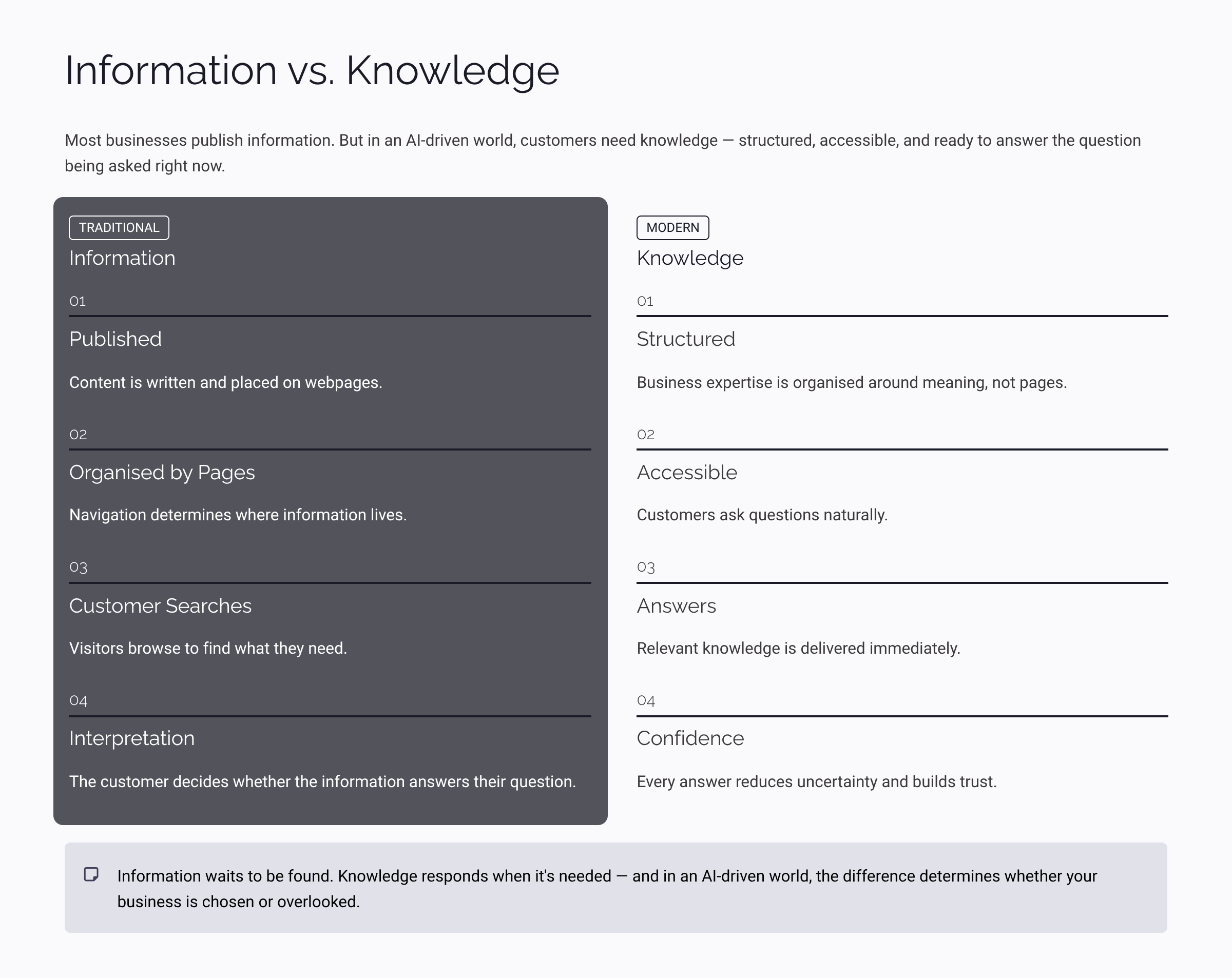
Information is passive.
It exists, waiting to be discovered.
Knowledge is active.
That distinction is becoming increasingly important.
Traditional websites are organised around information.
Visitors are expected to assemble the pieces for themselves.
Modern customer experiences are organised around knowledge.
Notice what has changed.
The objective is no longer to publish everything a business knows.
The objective is to make that knowledge immediately accessible whenever a customer needs it.
Whether the question comes through Google...
An AI assistant...
A conversational interface...
Or directly from a prospective customer...
The underlying knowledge should remain consistent.
The delivery mechanism may change.
The knowledge should not.
Businesses often invest significant time creating valuable expertise.
Unfortunately, much of that knowledge remains scattered.
The businesses that thrive in the next decade will not necessarily know more than their competitors.
They will simply make their knowledge easier to access, easier to understand, and easier to trust.
Key Insight
Information informs.
Knowledge removes uncertainty.
The businesses that organise knowledge—not just information—will create better customer experiences.
Throughout this paper, we've explored a series of connected ideas.
Together, these observations lead to a simple conclusion.
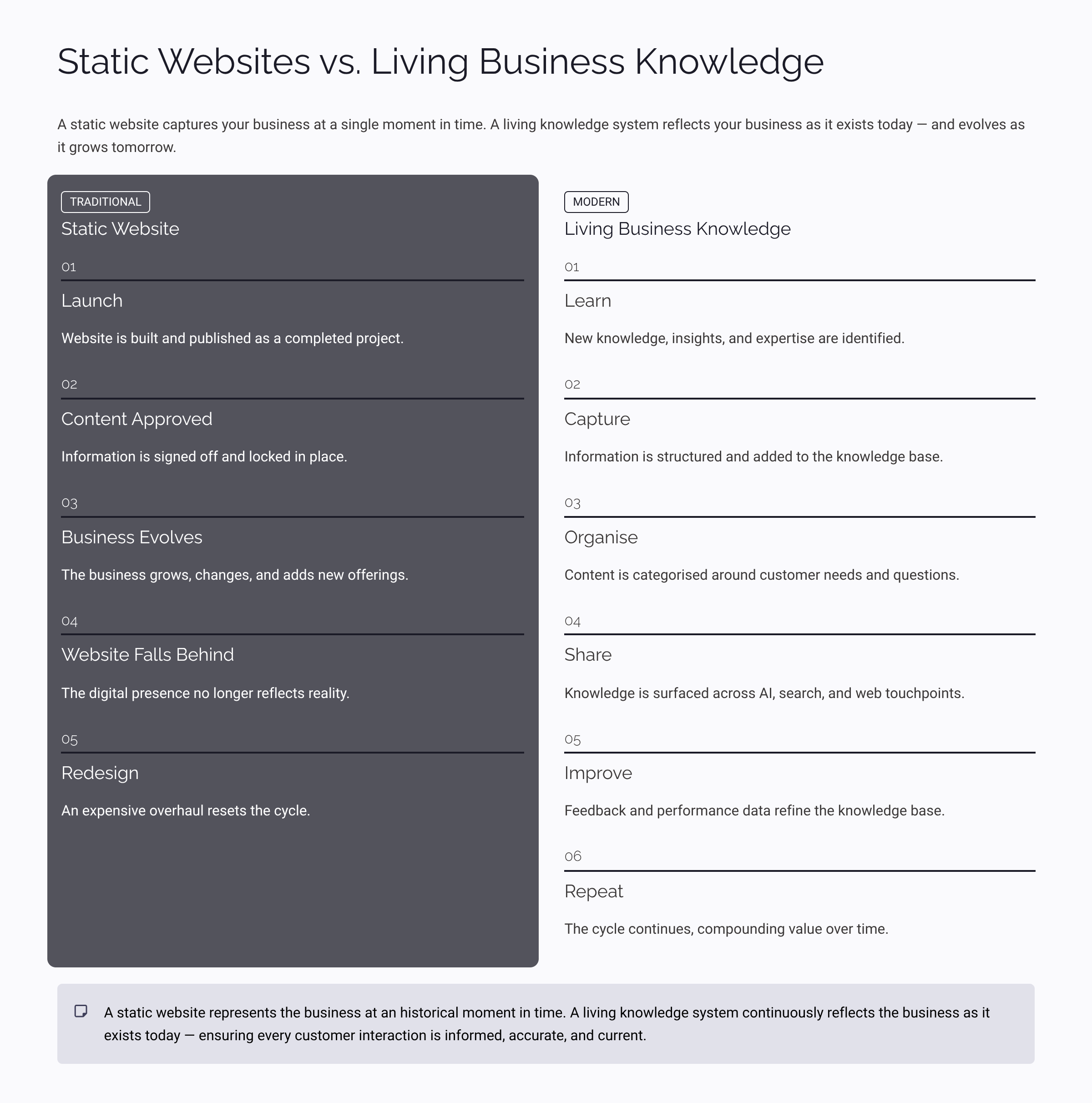
Business knowledge can no longer be treated as something that is created once and left unchanged.
For many organisations, that's exactly what happens today.
The result is more than an outdated website.
It is an outdated representation of the business itself.
We believe there is a better approach.
We call it Living Business Knowledge.
Living Business Knowledge recognises that a business is never complete.
Not during the next redesign.
Today.
Unlike a traditional website, Living Business Knowledge is designed to grow.
As the business changes, its digital presence changes with it.
This creates a powerful long-term advantage.
Knowledge doesn't simply accumulate.
It compounds.
The businesses that consistently invest in their knowledge become progressively easier to discover, easier to understand, and easier to trust.
Not because they publish more content.
Because they represent themselves more accurately.
Their digital presence becomes a living reflection of the business itself.
That is fundamentally different from maintaining a website.
It is continually developing an asset that becomes more valuable over time.
Key Insight
Your business changes every day.
Your knowledge should evolve with it.
Every investment in Living Business Knowledge makes the next customer interaction more valuable than the last.
One of the greatest strengths of a successful business is that it becomes better over time.
Not because its products change every day.
But because its understanding deepens.
Most businesses become more knowledgeable every year.
Unfortunately, their digital presence rarely reflects that growth.
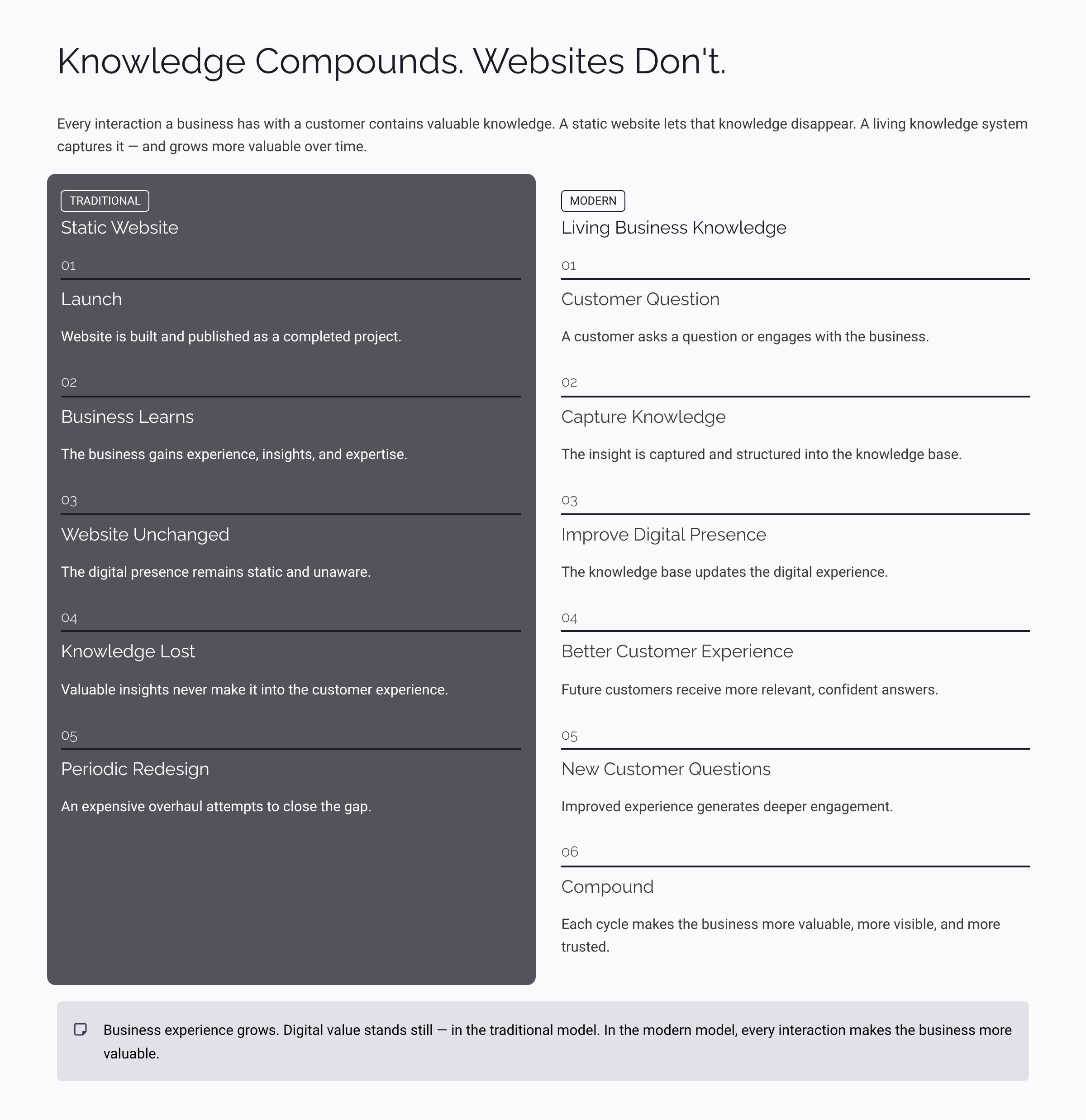
A website launched three years ago often contains the same structure, the same navigation, and many of the same pages it had on the day it went live.
Meanwhile...
Its digital presence has not.
Living Business Knowledge changes that equation.
Instead of treating expertise as something that accumulates quietly inside the business, it becomes an asset that grows visibly over time.
Knowledge doesn't simply increase.
It compounds.
That distinction matters.
Compounding creates competitive advantage.
Businesses that consistently capture and organise what they learn become progressively easier to discover.
Progressively easier to understand.
Progressively easier to trust.
Meanwhile, competitors who continue treating their websites as completed projects gradually fall behind.
Not because they stopped improving their business.
Because they stopped improving the way their business is represented.
The gap widens almost invisibly at first.
Then it accelerates.
By the time two businesses have been evolving for five years, one may possess hundreds of additional customer stories, refined explanations, industry insights, implementation examples, and answers to real customer questions.
The other still has the website it launched years earlier.
Both businesses gained experience.
Only one captured it.
That is the compounding advantage.
It cannot be purchased overnight.
It cannot be copied quickly.
It is earned through the continuous development of Living Business Knowledge.
The longer the process continues...the greater the advantage becomes.
Key Insight
Competitive advantage no longer comes only from what your business knows.
It comes from how effectively your business captures, develops, and shares that knowledge over time.
Throughout this paper we've explored a series of changes that are reshaping customer acquisition.
These are not isolated trends.
They are parts of the same system.
Customer acquisition has always been a journey.
What's changing is how that journey unfolds.
For many years, businesses focused almost exclusively on the beginning of that journey.
Those questions are still important.
But they are no longer sufficient.
Growth is created by the entire customer journey.
Not just the first interaction.
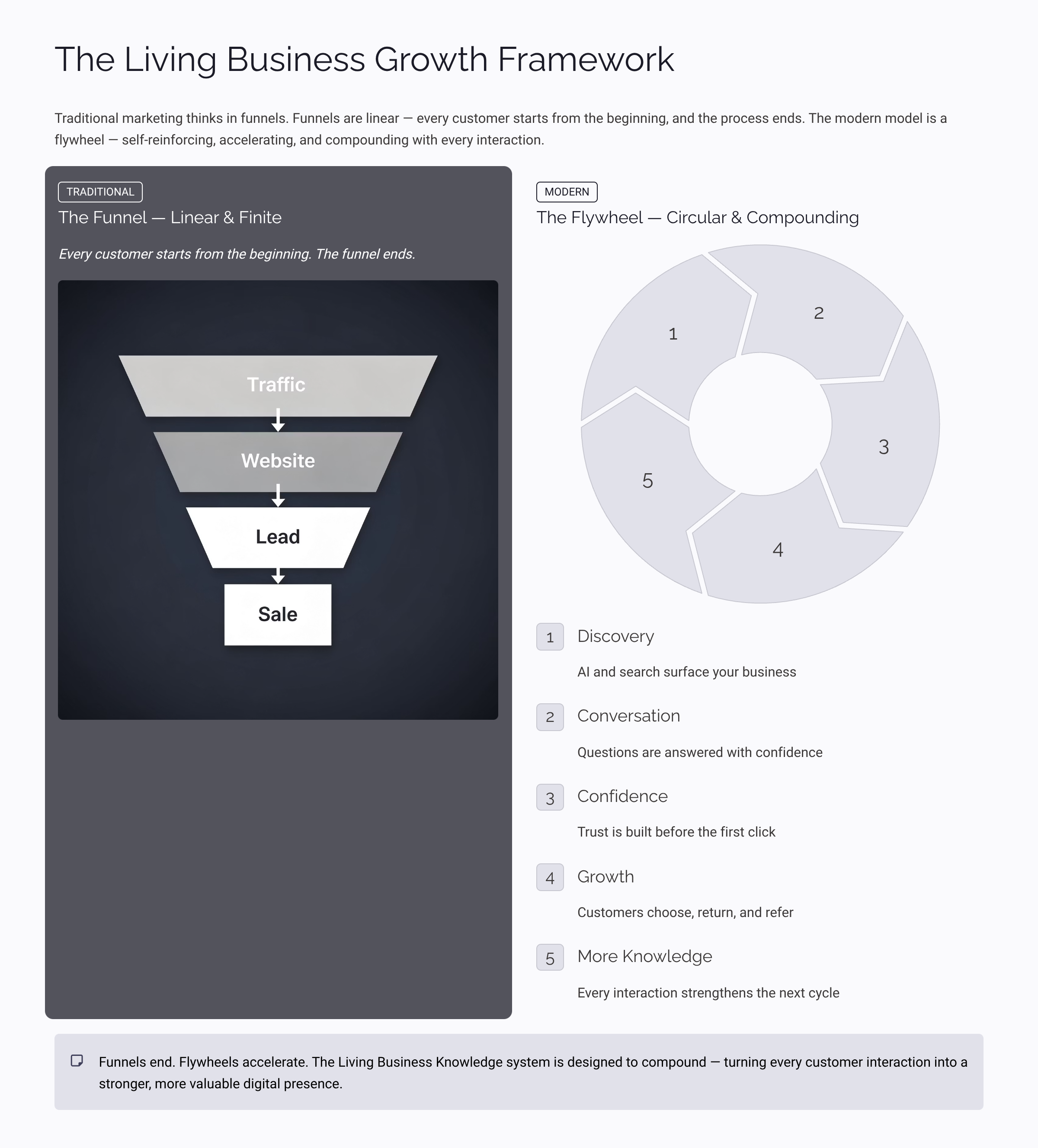
We think about that journey as five connected stages.
A prospective customer becomes aware that your business exists.
That may happen through Google.
Discovery creates awareness.
Nothing more.
The customer begins asking questions.
Every answer either builds confidence...
or creates uncertainty.
This is where businesses increasingly differentiate themselves.
Customers rarely buy because they've gathered enough information.
They buy because uncertainty has been reduced.
Confidence is the bridge between curiosity and action.
A customer interaction should never be viewed as a single transaction.
Every conversation contributes to an ongoing relationship.
Knowledge strengthens that relationship over time.
Growth is the outcome.
Not the objective.
Businesses that consistently improve the previous four stages naturally create more opportunities for sustainable growth.
Growth becomes the consequence of a better customer experience.
Not simply better marketing.
Notice what connects every stage.
Knowledge.
Living Business Knowledge is the thread that connects the entire framework.
Without it...
With it...
That is the difference between a collection of digital tools...
and a customer acquisition strategy.
Key Insight
Growth is not the first step.
It is the natural outcome of a customer journey built upon continuously evolving knowledge.
Knowledge is the only asset that improves every stage of the customer journey simultaneously.
For many businesses, digital marketing has become a waiting game.
For smaller MSPs competing against larger, well-established firms, that strategy has become increasingly difficult.
The largest providers have spent years building digital authority.
None of those achievements happened overnight.
And they are difficult to replicate quickly.
For many growing MSPs, this creates an uncomfortable reality.
Waiting to become visible in highly competitive search results can take years.
The business cannot afford to wait.
Fortunately, customer acquisition has never depended upon a single path.
Search remains important.
But it should no longer be viewed as the only source of opportunity.
The businesses growing most consistently today understand something different.
Rather than relying exclusively on prospective customers beginning the conversation...
By the time a buying decision arises, they are no longer unknown.
They are recognised.
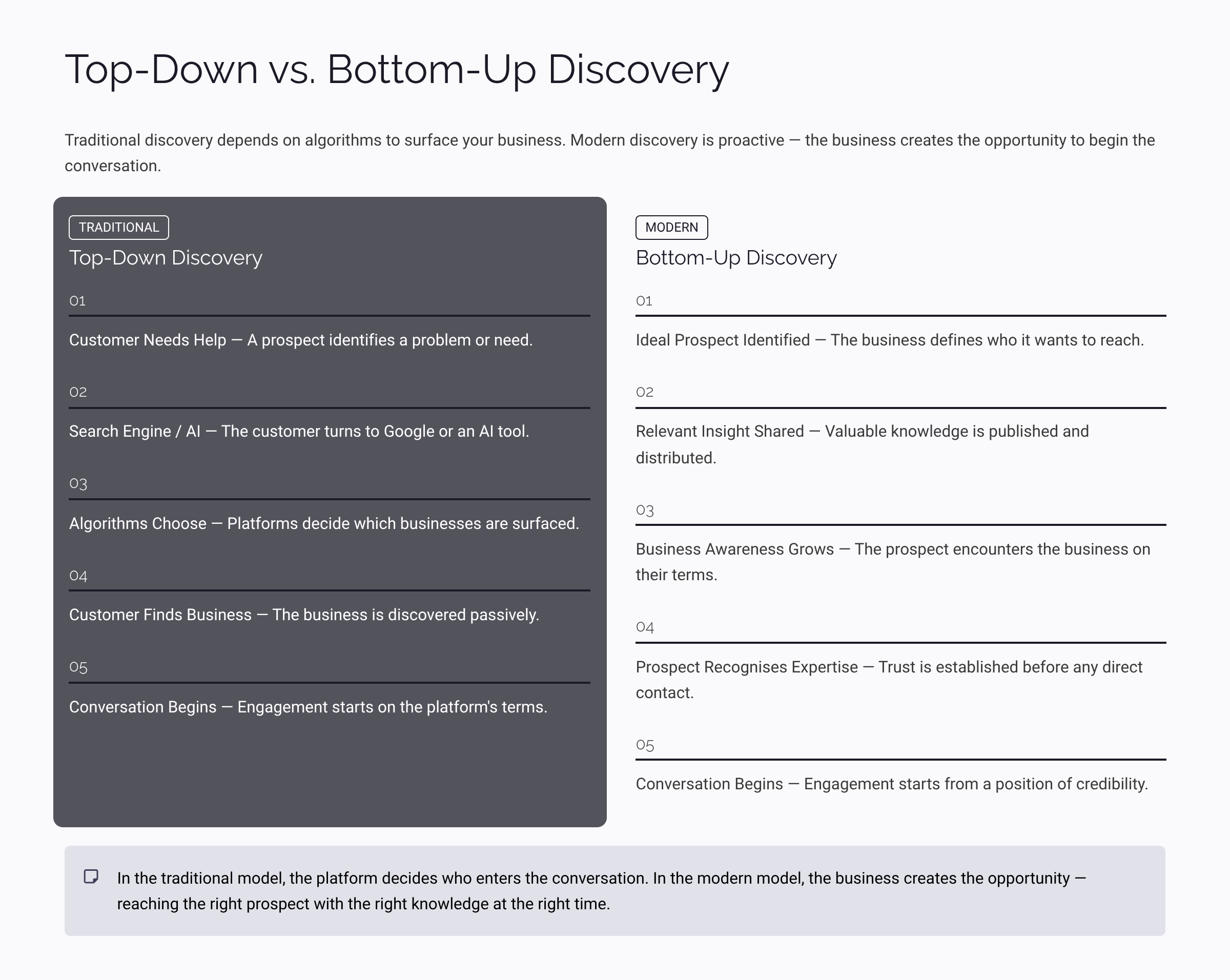
This represents a shift from what we describe as Top-Down Discovery to Bottom-Up Discovery.
Top-Down Discovery depends upon search engines deciding who becomes visible.
Bottom-Up Discovery depends upon businesses taking the initiative to introduce themselves to the right prospects through thoughtful, relevant communication.
Neither replaces the other.
The strongest customer acquisition strategies combine both.
Top-Down Discovery builds long-term authority.
Bottom-Up Discovery creates immediate opportunities while that authority continues to grow.
Together, they create a more resilient growth strategy.
One generates visibility.
The other generates awareness.
Both are essential.
Businesses that rely upon only one are increasingly placing unnecessary limits on their future growth.
Key Insight
Search helps customers discover businesses.
Thoughtful outreach helps businesses discover customers.
The strongest growth strategies combine both.
The best time to become known is before someone has a need for your services.
Throughout this paper we've argued that customer acquisition has fundamentally changed.
Together, these ideas form a different way of thinking about growth.
The obvious question is:
How does a business put these ideas into practice?
The answer is surprisingly simple.
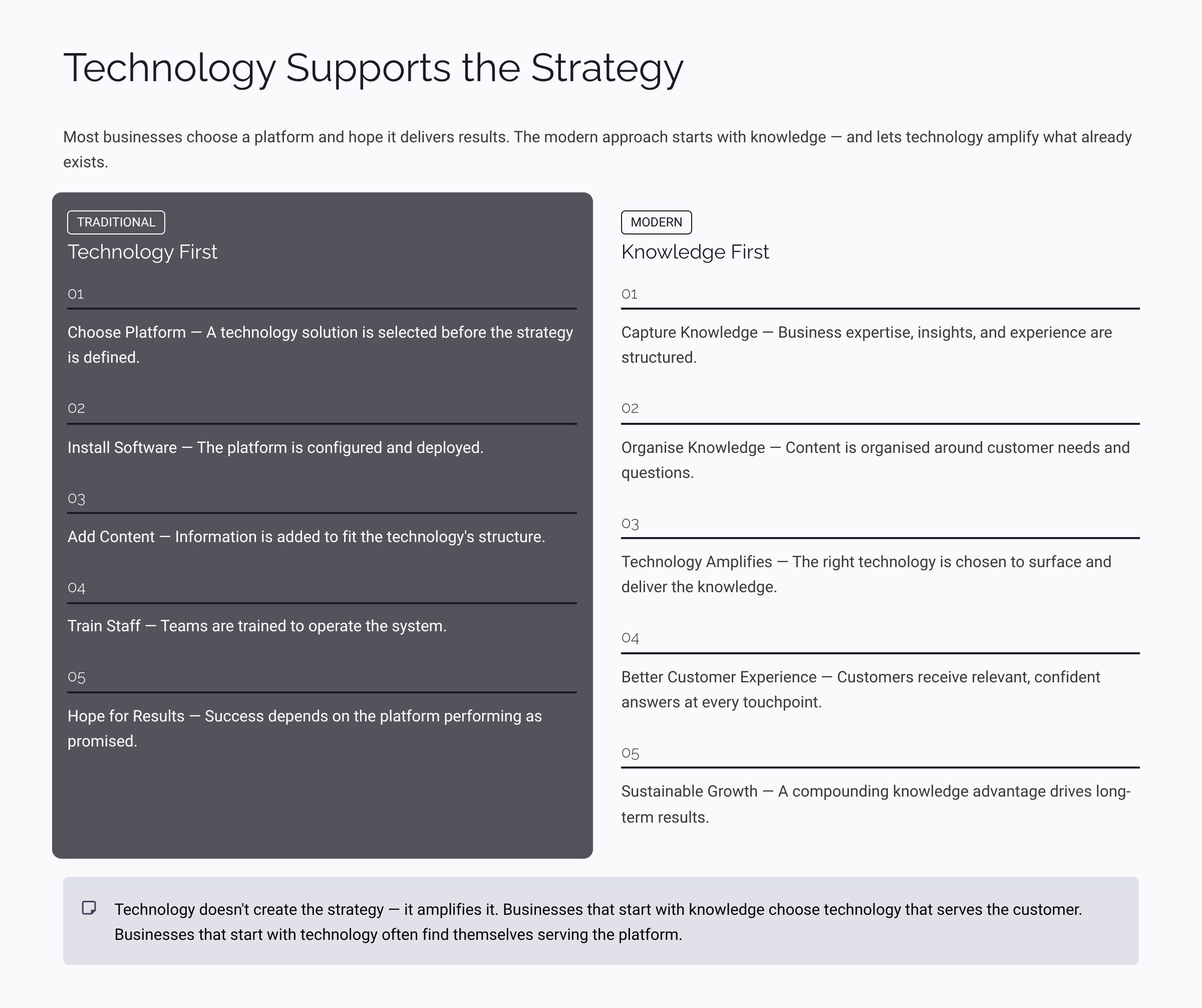
Don't start with technology.
Start with knowledge.
Ask a different set of questions.
Those answers become the foundation of your digital presence.
Once knowledge has been captured and organized, everything else becomes easier.
Technology supports this process.
It does not define it.
Too many businesses begin by asking:
"Which CRM should we buy?"
"Which chatbot should we install?"
"Which marketing platform should we choose?"
Those are important decisions.
But they are not the first decisions.
Without organized knowledge, every technology platform becomes another disconnected tool.
With organized knowledge, technology becomes an amplifier.
It makes existing expertise easier to discover.
The technology itself becomes almost invisible.
Customers rarely remember the platform they interacted with.
That is exactly how technology should behave.
The objective has never been to build a smarter website.
The objective has always been to create a better customer experience.
Everything else supports that goal.
Key Insight
Technology should amplify your knowledge.
It should never replace it.
Throughout this paper, we have explored a simple observation.
Customer acquisition has fundamentally changed.
Customer acquisition changed because customers changed.
Every significant shift in technology has reduced friction.
Business is simply adapting to the next stage of that evolution.
That evolution requires a different way of thinking.
For many years, businesses invested in websites.
Today, they must invest in knowledge.
Not knowledge that sits hidden within documents, proposals, and the experience of individual employees.
Knowledge that is continually captured.
Knowledge that becomes more valuable every time the business learns something new.
That is what we have described as Living Business Knowledge.
One that recognises a simple truth.
Businesses never stop learning.
Their digital presence shouldn't stop learning either.
The organizations that embrace this philosophy will not simply publish better websites.
And over time, they will create a competitive advantage that becomes increasingly difficult to replicate.
Those changes are inevitable.
The businesses best prepared for the future will not be those that chase every new technology.
They will be the businesses that continually capture, organise, and apply what they know.
Because knowledge is one of the very few business assets that becomes more valuable every time it is used.
Ultimately, this paper is not about websites.
It is about recognising that the digital representation of a business should evolve in exactly the same way the business itself evolves.
Your business changes every day.
Your knowledge should evolve with it.
Everything else is simply how you choose to make that happen.
The ideas presented in this paper did not emerge from a single technology, a single marketing trend, or a single product.
They emerged from observing thousands of interactions between businesses, customers, search platforms, and evolving technologies over many years.
Rather than viewing artificial intelligence as another marketing tool, we began asking a different question:
How should businesses represent themselves in a world where customers increasingly expect conversations instead of navigation?
That question ultimately led to the philosophy we describe as Living Business Knowledge.
Whether or not you agree with every conclusion in this paper, our hope is that it encourages a broader discussion about the future of customer acquisition—and the role knowledge will play in shaping it.
Related Reading:
Search Is Growing. Website Traffic Isn't. Why website traffic is declining even as search grows—and what MSPs must do to stay visible in the age of AI search.
Customers No Longer Browse. They Ask. Customers increasingly expect conversational answers instead of browsing websites. Learn why this changes customer acquisition for MSPs.
A Citation Creates an Opportunity - Not a Customer. AI citations create visibility, but visibility alone doesn't create customers. Learn what happens after discovery matters most.
The Website Is No Longer the Destination. Modern websites no longer begin the customer journey. They continue conversations already started through AI search and discovery.
Information Tells. Knowledge Answers. Information fills web pages. Knowledge answers customer questions. Learn why the difference matters in AI-driven customer acquisition.
Your Most Valuable Digital Asset Isn't Your Website. Your website isn't your greatest digital asset. Your business knowledge is. Learn why knowledge creates lasting competitive advantage.
Discovery Is Only the Beginning. Being discovered creates opportunity, not growth. Learn why customer conversations determine who ultimately earns the business.
The Customer Journey Has Changed. Today's customers move from discovery to confidence differently than ever before. Learn why the customer journey now revolves around conversation.
Every Generation of Technology Reduces Friction. Every major technology reduces customer effort. Discover why AI and conversational search are the next step in that evolution.
Why Customer Acquisition Needed a Different Approach. Businesses, customers, search, and technology have all changed. Learn why customer acquisition had to evolve with them.
Stop Waiting to Be Discovered. Smaller MSPs can't rely solely on search visibility. Learn why creating discovery is more effective than waiting to be discovered.
Your Business Knowledge Should Work Harder. Business knowledge shouldn't live in one place. Learn how reusing knowledge strengthens discovery, conversations, and customer growth.
Living Business Knowledge. Businesses evolve every day. Their knowledge should evolve too. Discover why Living Business Knowledge is becoming a competitive advantage.
Knowledge Compounds. So Does Competitive Advantage. Knowledge becomes more valuable every time it is captured and reused. Discover why compounding knowledge creates lasting advantage.
Where Do We Go From Here? Customer acquisition has changed. The question now is how your business will adapt. Explore the next step toward sustainable growth.