

Throughout this Executive Brief series, we've explored a simple but powerful idea: customer acquisition has fundamentally changed. Businesses have evolved. Customers have evolved. Search has evolved. Technology has evolved. The question is no longer whether these changes are happening. The question is how businesses choose to respond.
Every period of technological change creates two kinds of organisations.
Those that attempt to preserve the past.
And those that prepare for the future.
History consistently rewards the second group.
Not because they adopt every new technology.
But because they recognise changing customer expectations before their competitors do.
That is where sustainable growth begins.
Over the course of this series, we've explored a different way of thinking about customer acquisition.
Not as isolated marketing activities.
But as one continuous customer experience.
We've argued that:
None of these ideas exist independently.
Together, they form a different philosophy for how businesses grow.
The future won't belong to businesses with the largest websites.
Or the most pages.
Or even the highest search rankings.
It will belong to businesses that make it easiest for prospective customers to understand who they are, what they know, and why they can be trusted.
Those are not challenges.
They are opportunities.
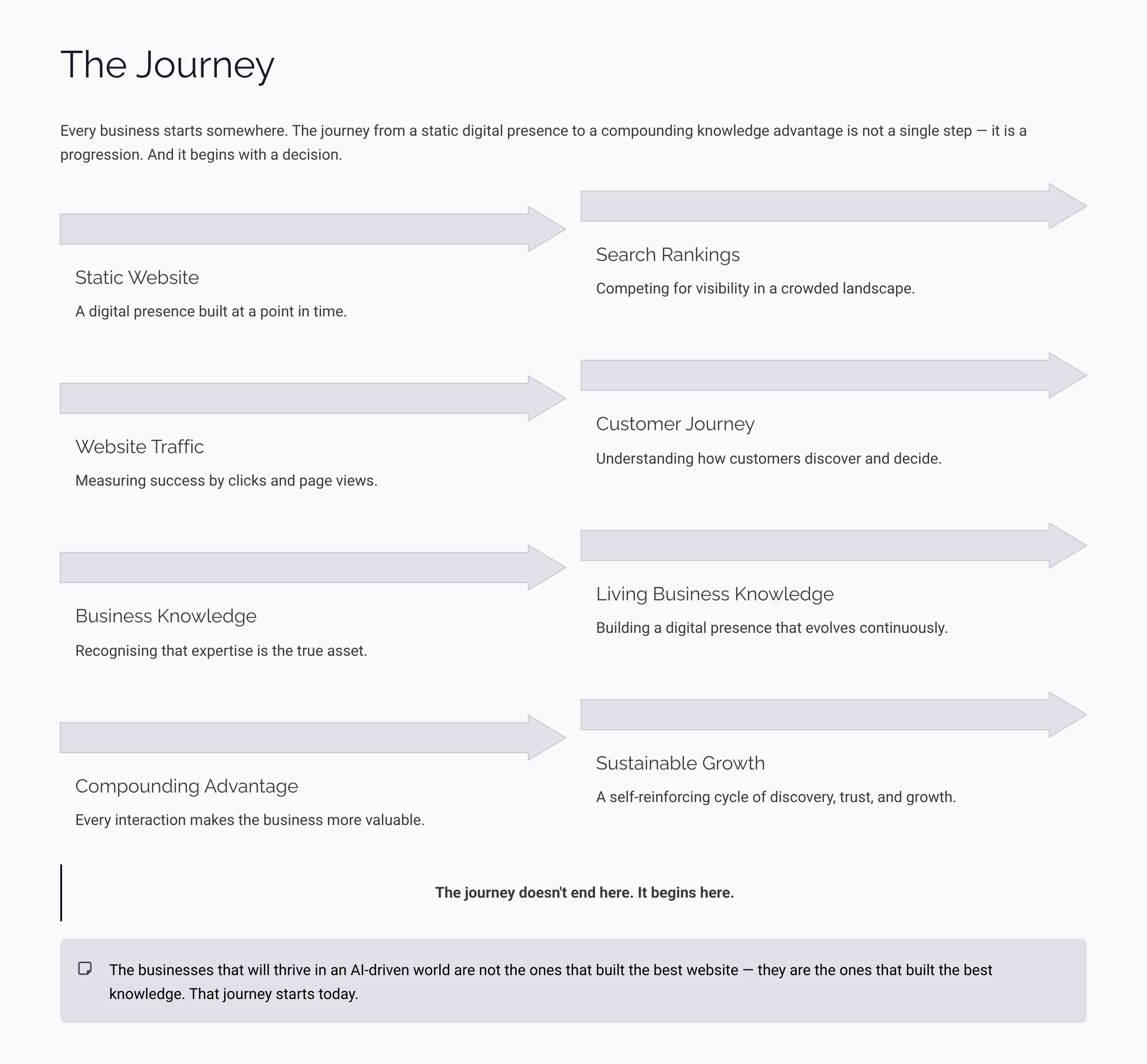
Your business changes every day. Your knowledge should evolve with it. Everything else is simply how you choose to make that happen.
If you were building your business for the first time today—not ten years ago—what would you do differently?
Thank you for following our Executive Brief series:
From Static Websites to Living Business Knowledge
If these ideas have challenged the way you think about customer acquisition, we invite you to continue the conversation.
Executive Briefs explore the evolution of customer acquisition in the age of AI search, conversational experiences, and Living Business Knowledge. Together, they form a connected body of thought leadership designed to help business leaders rethink how trust, knowledge, and customer confidence create sustainable competitive advantage.
The ideas presented in this paper did not emerge from a single technology, a single marketing trend, or a single product.
They emerged from observing thousands of interactions between businesses, customers, search platforms, and evolving technologies over many years.
Rather than viewing artificial intelligence as another marketing tool, we began asking a different question:
How should businesses represent themselves in a world where customers increasingly expect conversations instead of navigation?
That question ultimately led to the philosophy we describe as Living Business Knowledge.
Whether or not you agree with every conclusion in this paper, our hope is that it encourages a broader discussion about the future of customer acquisition—and the role knowledge will play in shaping it.